
 Svenska
 English
 Norsk
Norsk
 Suomi
Suomi
 Dansk
Dansk







Dishwashing School

Tips from Our Dishwashing Service Technicians
To succeed in the dishwashing area, good routines are essential. Here are the technicians’ best tips to avoid problems and unnecessary costs.
-
Preparation is key: Scrape off food residues thoroughly to avoid unnecessary re-washing. Soak cutlery.
-
Rinse correctly: Rinse dishes in the rack with water at a maximum temperature of 35°C. If the water is too hot, starch and proteins will stick.
-
Check the machine: Before starting – make sure filters and wash arms are clean and move freely. Check that the wash water is fresh and that any curtains are properly in place.
-
Chemicals: Ensure there is enough detergent and rinse aid and that the dosing equipment works properly.
-
Temperatures: Wash temperature should be at least 60°C and final rinse between 80–90°C to guarantee hygienic cleanliness.
Wash clean in 6 steps

1. Check the dish equipment.
Check that the dishwasher is clean.
Put back loose parts.
Check that there are enough DISH WASHING DETEGENTS and DRYING AGENTS.

2. Water and temperature.
Fill up the water tank and check the temperatures.
Dish temperature: 60°C
Rinse temperature: 85°C

3. Preparation of cutlery and plates.
Scrape off leftovers and thoroughly rinse cutlery and plates.
The cutlery should be soaked and WASHED TWICE, first lying down the standing upright.

4. Sort the dishes in right dash racks.
Plates, glasses and cutlery should be sorted separately.

5. Pre-wash the dish.
Pre-wash the dish at a temperature of max. 35°C.
If you have too high a temperature when you pre-wash, you risk that starch burn into the dishes.

6. Clean the dishwasher.
The dishwasher must be cleaned thoroughly every night.
Do NOT use foaming agents.
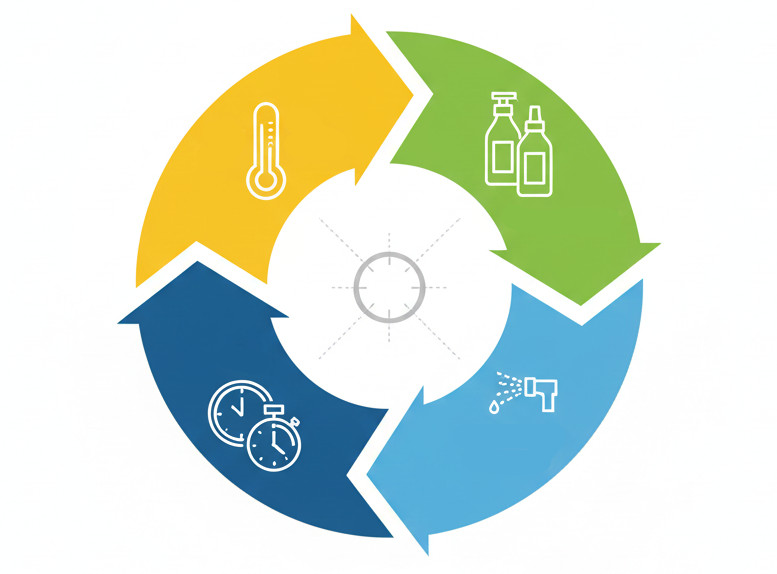
Sinner's circle.
Sinner’s Circle – 4 Factors for Clean Dishes
To achieve a perfect dishwashing result, four factors must work together in balance. This model is called Sinner’s Circle. The principle is simple: If you reduce one factor (e.g., wash at a lower temperature), you must increase another (e.g., extend the washing time or increase the amount of chemicals) to maintain the result.
The four factors are:
-
Chemicals: The detergent dissolves dirt, grease, and proteins, while the rinse aid breaks surface tension so water runs off quickly and dishes dry.
-
Mechanical Action: How forcefully the water hits the dishes. This is controlled by the pump strength and spray arms. Important: Clean nozzles and filters often so nothing blocks water pressure!
-
Time: The time water, heat, and chemicals need to work on the dirt. Always follow the machine’s recommended program length.
-
Temperature: Heat activates the detergent and disinfects the items. Correct temperature at each stage is crucial:
-
Pre-rinse: Max 35°C (to avoid burning proteins onto the surface).
-
Wash: At least 60°C (for cleaning and chemical activation).
-
Final rinse: 80–90°C (for hygiene and quick drying).
-

Water Hardness – An Invisible Factor
Water hardness is a measure of how many minerals the water contains (mainly calcium and magnesium). For anyone working with dishwashing, this is essential knowledge.
Water hardness levels in Sweden:
 0 - 6 °dH = Soft
 7 - 13 °dH = Medium hard
 14 - 20 °dH = Hard
Hard water: In regions with hard water, lime “consumes” part of the detergent, which requires a higher dosage. There is a high risk of lime deposits on dishes and on the machine’s heating elements. We recommend an Anti-lime detergent to prevent this and reduce energy consumption.
Soft water: In areas with soft water (0–6 °dH), less chemicals are needed. However, if the water is too soft (0–4 °dH), foam can form, reducing the washing effect. Feel free to contact our technicians for help with exact dosing based on your water.
Unsure about your water? Contact our knowledgeable dishwashing technicians. We will help you measure the water hardness in your area and adjust your equipment for optimal results.
The Right Machine for the Right Need
There is a huge difference between professional dishwashers for large kitchens and ordinary household machines. A household dishwasher simply doesn’t have the capacity or speed required when the pace is high. While a household wash takes hours, a restaurant dishwasher can often complete a cycle in as little as 30 seconds.
On the market, there are mainly four types of machines depending on your operation’s size and workflow:
/storage/.../underbankdiskmaskin.jpg
Undercounter Dishwasher
Compact and practical model that fits under a counter. The perfect choice for bars, cafés, and smaller kitchens where space is limited but cleanliness requirements are high.
/storage/.../huvdiskmaskin.jpg
Pass-Through Dishwasher
The workhorse and standard choice in most restaurant kitchens. Provides an ergonomic working height with infeed and outfeed tables and quickly handles large volumes of dishes.
/storage/.../tunneldiskmaskin.jpg
Conveyor Dishwasher
For really large volumes (400+ servings). A fully automated flow where dishes enter on one side and come out clean on the other.
/storage/.../grovdiskmaskin.jpg
Pot Washer
The kitchen’s best friend for containers, pots, and trays. Often equipped with granules (small plastic beads) that blast away burnt-on food, eliminating the need for time-consuming soaking and scrubbing.
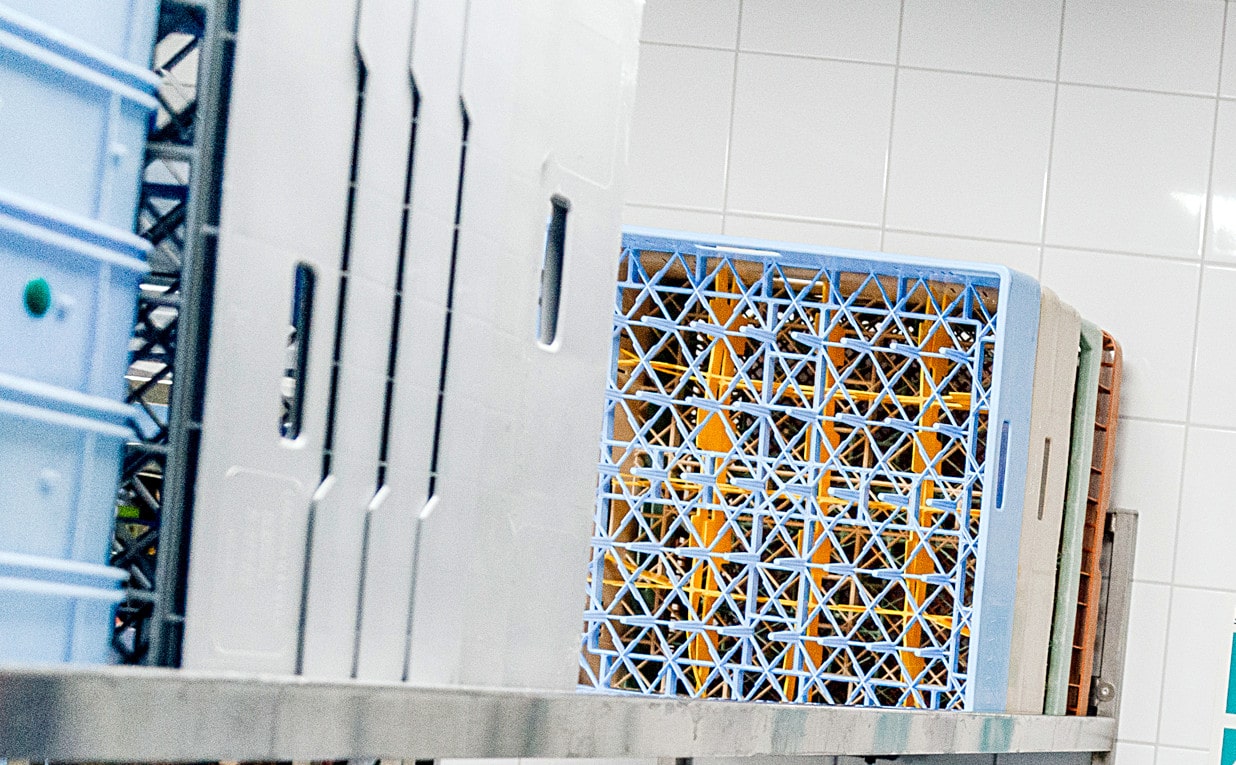
Dish Racks and Equipment
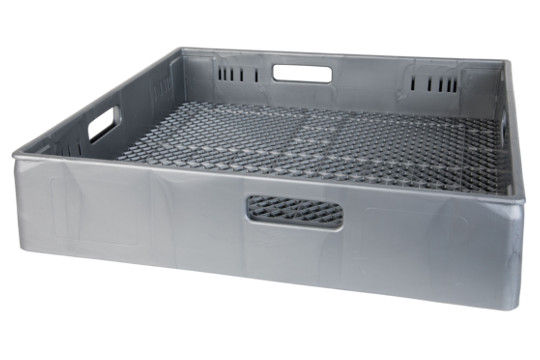
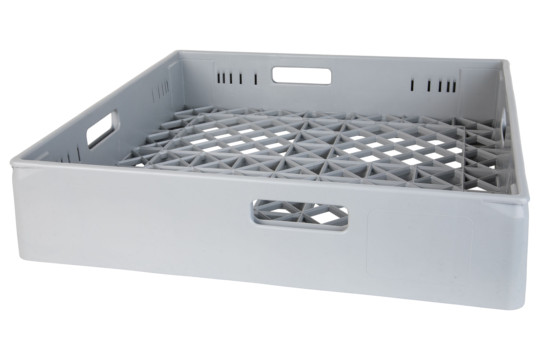
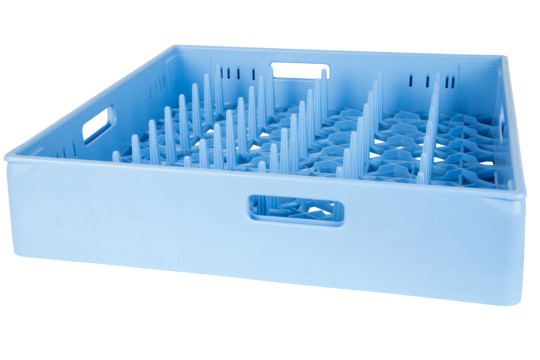
The right equipment is the key to a smooth workflow in the dishwashing area. By using customized dish racks and accessories, you not only make the staff’s daily work easier – you also ensure that dishes are clean on the first attempt and minimize the risk of glass breakage.
The right equipment contributes to:
- Optimal washing results
- Minimal breakage and wear
- Lower energy and chemical consumption (no rewash)
- Better ergonomics and working environment
The standard size for professional dish racks is 50x50 cm. Here we explain which rack fits which purpose.
Types of Dish Racks
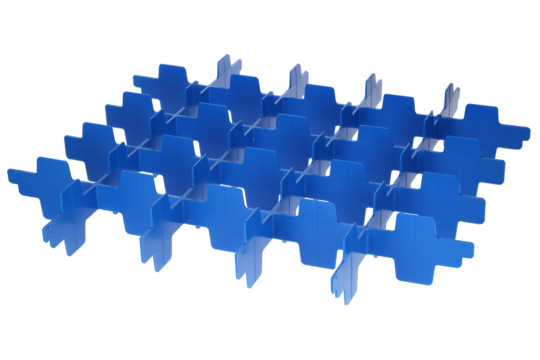
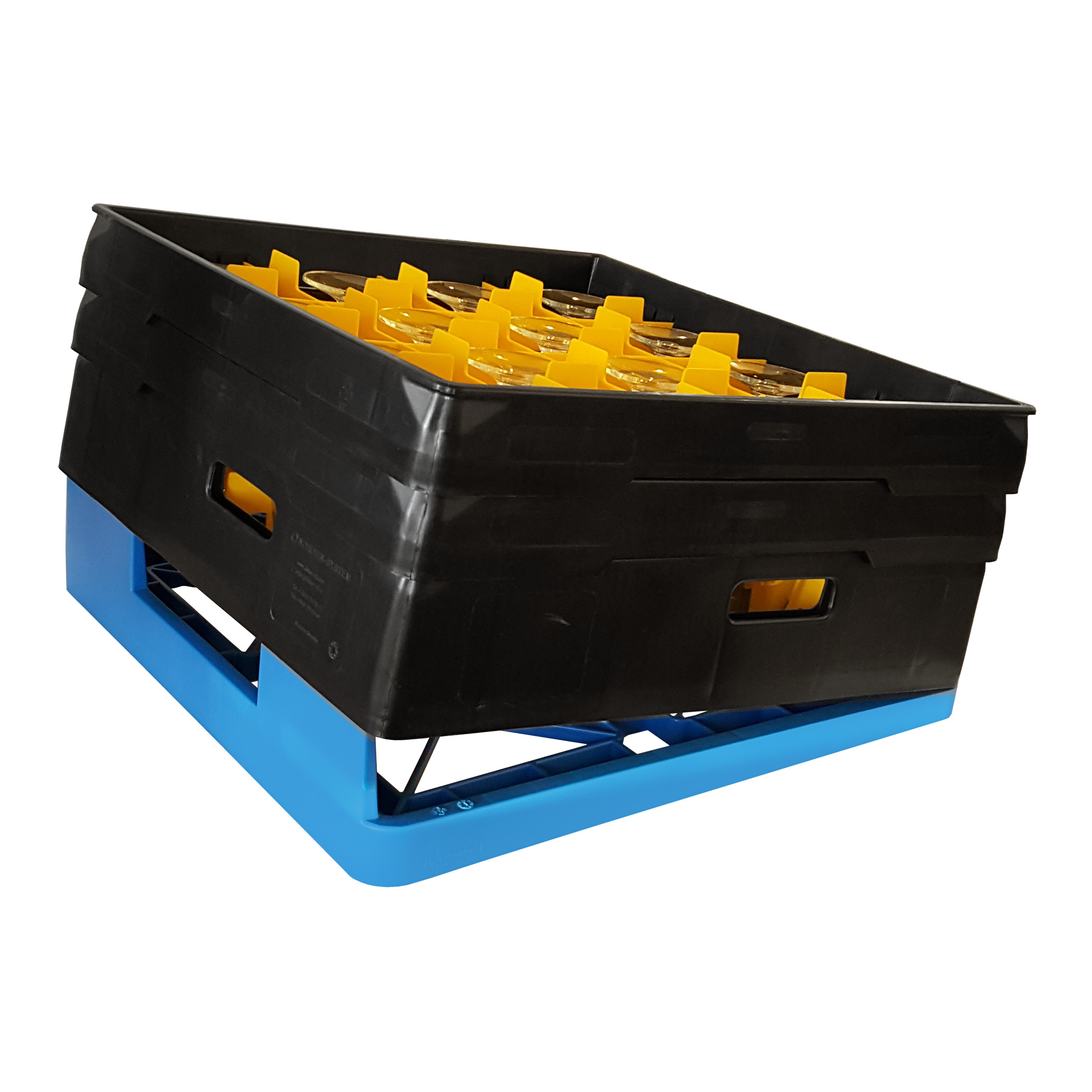
Compartment inserts for glass racks.
Compartment inserts help to protect tall and delicate glasses when washing. Compartment inserts for glass racks are available in several different models that are placed inside glass racks. The different models suits different types of glass. In our range you will find compartment inserts from 16 up to 49 glasses.
Safety in the Dishwashing Area
pH Value and Safety
Understanding the pH scale is the foundation for a safe working environment. The scale ranges from 0 to 14, where 7 is neutral.
- Acidic (low pH): Often used to remove lime scale.
- Basic/Alkaline (high pH): Used to dissolve grease and proteins.
Important: Professional dishwashing detergents are often strongly alkaline. Always use the prescribed protective equipment – protective gloves, apron, and safety goggles – when handling concentrated chemicals.
Employer’s Responsibility
According to the Work Environment Act, it is the employer’s responsibility to assess risks. There must be clear routines for chemical handling and first aid equipment (e.g., eye wash station) easily accessible near the dishwashing area.
Ensure that Safety Data Sheets are available to staff and that warning signs are clearly visible.
Hazard Symbols to Know
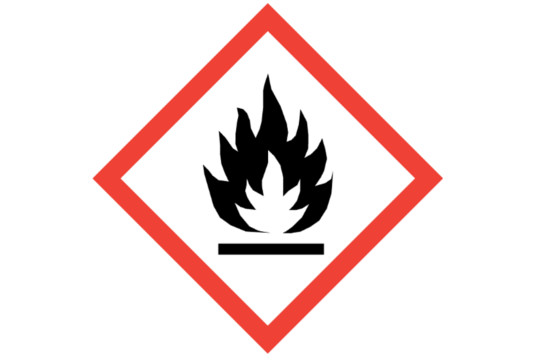
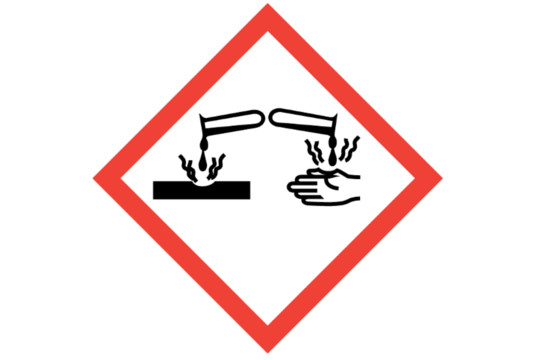
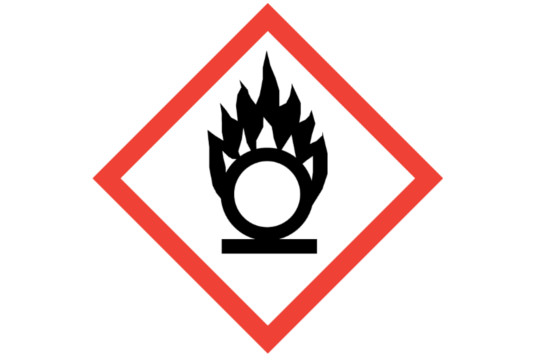
In the dishwashing area, substances are handled that can be harmful if used incorrectly. Here are the most important symbols according to the CLP regulation:

Protect Yourself from Chemicals
Machine dishwashing detergents can cause permanent eye damage in just a few seconds. The greatest risk often occurs when changing containers.
Protect yourself: Always wear safety goggles/visor and chemical-resistant gloves when handling concentrates.
Eye wash: Every dishwashing area must have a functioning eye wash station.
In case of splashes: Rinse immediately and thoroughly for at least 15 minutes.
Medical care: In case of eye injuries caused by chemicals, always seek emergency medical attention.

If the dishes are not clean.
If something is not working correct, we are quickly there to assist you. However, there are a number of things you can check easily if you experience that your dishes is not clean enough.

Service request
To submit a service request or book service/repair, please use the form.
Go to service request →
Urgent dishwasher issue?
In case of urgent breakdowns, you can contact our service hotline (open every day, including weekends).
Service hotline: +4631 - 381 53 40
Opening hours: Mon–Thu 08:00–16:30 | Fri 08:00–22:00 | Weekends 10:00–22:00
In case of urgent breakdowns, you can contact our service hotline (open every day, including weekends).
Service hotline: +4631 - 381 53 40
Opening hours: Mon–Thu 08:00–16:30 | Fri 08:00–22:00 | Weekends 10:00–22:00
Common issues & Simple solutions
Many issues are caused by simple problems that can be quickly resolved on your own.
Have you checked that the power is on, the water tap is open, and the filters are clean?
We have collected and created short videos showing how to quickly check and resolve the most common issues.
Watch instructional videos →Author: Tingstad
Last Updated: 2025-12-11
Customer service
About us
Stores
We can help you!
Visiting Address:
Marieholmsgatan 1, 415 02 Gothenburg
Post Address:
Box 13013, 402 51 Gothenburg





Shop safely with

